HC grants bail to Chaitanya Baghel in Chhattisgarh liquor scam
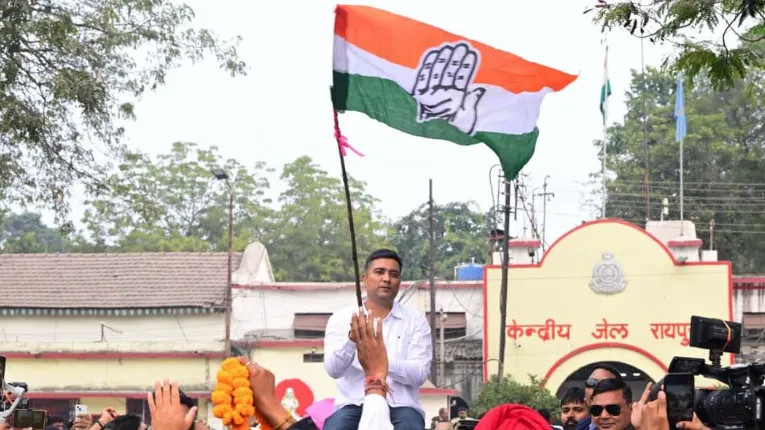
Raipur | Correspondent: Chaitanya Baghel, son of former Chief Minister Bhupesh Baghel, was released from Raipur Central Jail after approximately 170 days, following the completion of formal legal procedures for his bail in a money laundering case related to the Chhattisgarh liquor scam. Upon his release from jail, a large crowd of supporters gathered as he left for his home, causing a traffic jam on the road.
Before Chaitanya's release, former Chief Minister Bhupesh Baghel held a press conference and, visibly emotional, said that Chaitanya was arrested on July 18th, his birthday, and is being released today on his grandson's birthday. He described it as an emotional moment for the family.
Bhupesh Baghel himself drove to Raipur Central Jail to pick up his son.
It is noteworthy that Chaitanya Baghel was granted bail just a day earlier in cases registered by the Enforcement Directorate (ED) and the Chhattisgarh Anti-Corruption Bureau/Economic Offences Investigation Wing. The ED had arrested him last July in connection with a money laundering investigation. Later, in September, the Anti-Corruption Bureau arrested him in another corruption-related case while he was already in jail.
According to the investigating agencies, the alleged liquor scam took place between 2019 and 2022, causing significant losses to the state exchequer. The ED alleges that Chaitanya Baghel was the patron of this entire liquor syndicate and personally handled transactions worth approximately one thousand crore rupees. The Anti-Corruption Bureau claims that Chaitanya Baghel received around 200 to 250 crore rupees as his share, and the total amount involved in the entire scam could be more than 3,200 crore rupees.
After his son was granted bail, Bhupesh Baghel said that it was a victory for truth. He said that truth can be troubled, but it cannot be defeated. What the Court Said
Earlier on Friday, the Chhattisgarh High Court, while granting bail, explained in detail in its order the reasons for its conclusion and why it found the actions of the state government and investigating agencies to be weak on legal grounds. The court clarified that it was not determining through this order whether the accused was guilty or innocent, but at the bail stage, it is the court's responsibility to determine whether it was truly necessary to keep a person in jail, and whether their arrest and detention were in accordance with the Constitution and the law.
The court first examined the background of the entire case. It stated that the investigation is related to the alleged liquor scam between 2019 and 2023, in which the EOW/ACB registered an FIR based on a letter from the ED. The High Court specifically noted that Chaitanya Baghel's name was not in the FIR and, despite a lengthy investigation, he was not among the list of main accused. The investigation lasted approximately 21 months, during which the main charge sheet and several supplementary charge sheets had been filed. The court said that when the investigation had progressed to this extent, the sudden arrest of the accused raises the question of whether the detention was truly necessary.
The High Court made a very important observation regarding the arrest. The court said that, according to the law, arrest is not a routine procedure, but a last resort. According to the new BNSS system and several Supreme Court judgments, the police have to demonstrate that the investigation cannot proceed without the arrest, that there is a risk of the accused absconding, tampering with evidence, or influencing witnesses. According to the court, the state and the police failed to present concrete evidence on any of these points. The investigating agency itself had admitted that the interrogation of the accused was completed in just a few hours and that no new recovery or disclosure was made during his custody. In such a situation, the court said that the detention appears to be a mechanical step rather than a necessity for the investigation.
The court also stated that the investigation in this case is primarily based on documents and bank records. Most of the documents were already in the possession of the ED and state agencies. In such cases, the argument that the accused would tamper with evidence if released is inherently weak. The court clearly stated that a person cannot be kept in jail merely on the basis of suspicion or apprehension.
The court's comments on the state and police's major procedural lapses were even harsher. The High Court stated that the law mandates obtaining prior permission from the court for "further investigation" after the filing of the charge sheet, to prevent arbitrary investigations. However, in this case, the agency filed several supplementary charge sheets one after another, added new accused, and nowhere did it show that due permission was obtained. The court termed this a "systemic flaw" and said that such a process not only violates the rights of the accused but also weakens the entire prosecution.
The High Court also observed that at the time of the arrest, the investigating agencies already possessed substantial material. If the agency was already aware of the accused's role, then not arresting him for such a long time and then suddenly taking him into custody raises suspicion in the court's eyes. Citing previous Supreme Court judgments, the court said that such an arrest could fall under the category of mala fide intent or "timing irregularities," and courts cannot blindly accept the state's arguments in such cases.
The court also addressed the allegations of influencing witnesses in detail.
The court acknowledged the state's argument that the accused belongs to an influential family and has political clout, but stated that merely being influential is not, in itself, a ground for denying bail. Unless it is shown that the accused has actually intimidated or threatened witnesses, or attempted to do so, this apprehension will be considered legally weak. The court also added that if the accused violates the bail conditions in the future, the state will have every right to seek cancellation of bail.
The court also considered the aspect of a lengthy trial. It noted that the number of accused, witnesses, and documents in the case is very large, and there is no realistic possibility of the trial concluding quickly. In such a situation, keeping a person in jail indefinitely, while they have not yet been proven guilty, would be a violation of their personal liberty under Article 21 of the Constitution. The court clearly stated that prolonged detention in jail gradually takes the form of punishment, which is against the spirit of the law.
The High Court concluded that the state and the police failed to meet the legally required criteria to justify the arrest, further investigation, and detention. The court reiterated that "bail is the rule and jail is the exception," and in this case, no exceptional circumstances were presented to justify denying bail. For these reasons, the court decided to grant bail to Chaitanya Baghel with stringent conditions, while making it clear that this order does not constitute a final comment on the merits of the case.